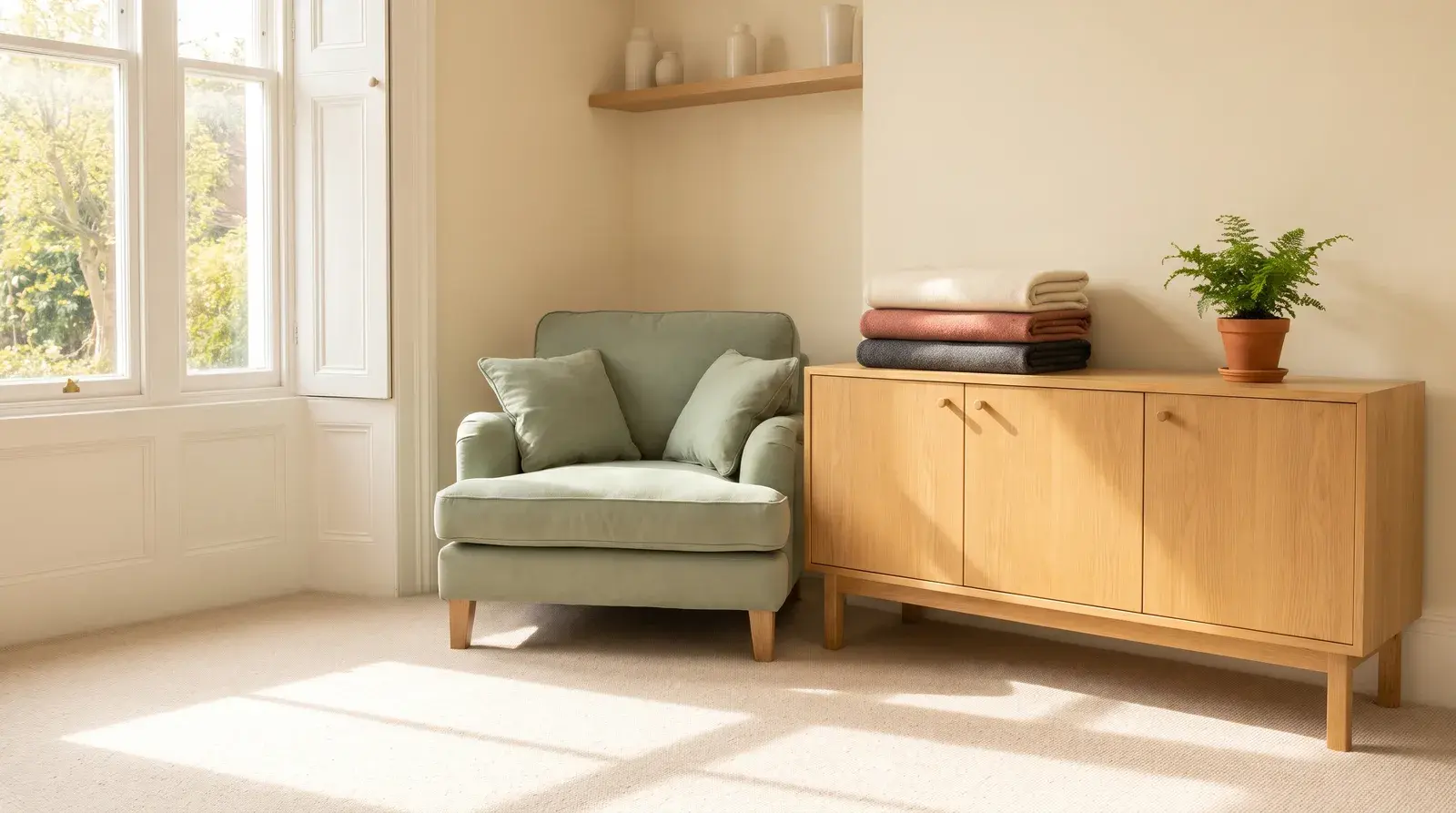
A charity will usually collect the things it can sell, but it will not normally empty a whole house for nothing. A charity house clearance that takes everything is usually a paid service. And the sofa or armchair a charity shop turns down still needs somewhere to go.
That is the part a house clearance covers. We empty the whole house, and anything usable goes to charity rather than to the tip. Items that can be donated or easily recycled help bring the cost down. Over 95% of what we take away is recycled or reused.
So it is rarely a choice between a charity and a clearance firm. A good clearance is how the useful things reach a charity shop while the rest of the house still gets emptied.
Will a charity clear a whole house for free?
Not usually. A free charity collection is for a few things in good enough condition to sell in a shop. Think of a chest of drawers, a dining set or bags of clothes.
Some charities do run a house clearance service of their own. The ones we read are paid for and booked ahead. They are priced on much the same things a clearance firm prices on:
- the van and the driver
- how far away the property is
- how much there is
- what it costs to dispose of what cannot be sold
So if the whole house needs emptying, you are comparing two paid services. The question to ask both is the same: will you take everything, including the things nobody can sell?
Why will a charity not take a sofa without a fire label?
Because a charity shop is selling it on, and upholstered furniture sold second-hand has to pass the same fire tests as new furniture. The permanent fire label sewn into a sofa or armchair is how a shop can see that it does.
The rules are the Furniture and Furnishings (Fire) (Safety) Regulations 1988. Regulation 14 covers second-hand furniture. It applies the fire tests in regulations 5, 6 and 8, which deal with the upholstery, the filling and the cover. The label itself is regulation 11, the permanent label.
The government's guidance comes from the Office for Product Safety and Standards. It says it in one line: "Second-hand supply of furniture will also still require a permanent label".
So a sofa with its label cut off, or one that has faded past reading, is one a shop cannot sell. Turning it down is the charity following the rules, and it says nothing about how good the sofa is.
The rules are about upholstery and filling. A wooden table, a bookcase or a chest of drawers has neither, so the label question does not come up.
Does the fire label rule apply to old furniture?
No, not to furniture made before 1 January 1950. Regulation 4 says the requirements do not apply to goods manufactured before that date.
One thing did change recently. From 30 October 2025 the display label, the swing tag that used to be attached to new furniture, stopped being required. The government guidance says that change does not touch the permanent label. So the permanent label is the one that counts, on a new sofa and on a second-hand one.
What happens to the furniture a charity turns down?
It goes with the rest of the clearance. We take it along with everything else in the house. You do not have to find a home for it, hire a skip or make trips to the tip.
Everything we take leaves on our own waste carrier registration, CBDU634717, Upper Tier, which you can look up on the Environment Agency's public register. It goes to licensed sites, where it is sorted rather than tipped in one load. Anything that can be resold or donated is, recyclables are recycled, and only what remains is disposed of.
At the end of the job you get a waste transfer note. It records what left the property and who took it, and it is yours to keep.
Can a house clearance still send things to charity?
Yes, and on our jobs it is part of the work rather than an extra. Clothes, furniture and anything else with life left in it goes to charity rather than to landfill.
You do not need to sort it, bag it or drive it anywhere first. Take as long as you need to go through things and keep what matters to you. Then leave the rest to us, because the sorting is our job.
It also helps with the cost. A clearance is priced partly on what it costs to dispose of the load. Every chair or bag of clothes that is used again is weight nobody pays for at the tip.
If the family would like one particular piece to go to one particular charity, keep that piece back and take it to them yourselves. Everything else can stay exactly where it is for us.
When is it time to ring a clearance firm?
Ring us when the whole house needs emptying, or when a charity has said no to the sofa and the armchairs. Or ring when you simply want it handled in one go. We have been clearing houses across Suffolk and Essex for 16 years.
The first step is a visit. We come and look first, then quote, and the quote is free. If you are at the property and can send photographs, we can usually price it straight away. Otherwise you will hear back the same day, and within 24 hours at the latest.
If you live away, that is fine too. We can collect the keys from the solicitor or the estate agent and drop them back when we are done. You never have to be at the property at all.
Read more about house clearance in Suffolk, including what goes to charity from a Suffolk clearance, or see what a full house clearance includes. If it follows a death in the family, our probate and bereavement clearance page explains how we work with executors. Or ring the office on 01787 703059.